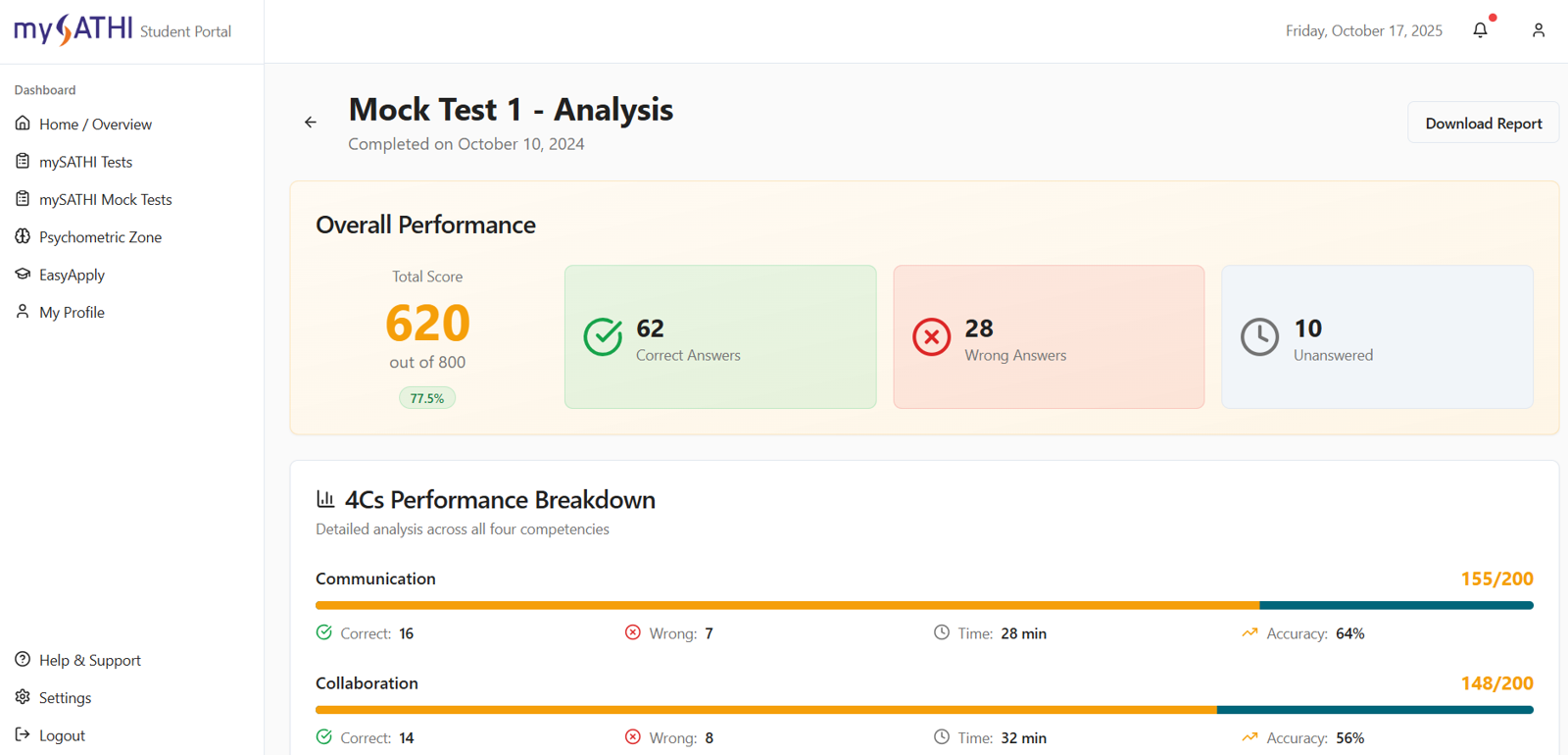
Comprehensive Diagnostic Reports
Detailed insights across all four competencies with actionable feedback
mySATHI (Scholastic Aptitude Test for Higher Education Institutions) is India's first global-standard, on-demand, computer-adaptive entrance examination. It is designed to transform undergraduate admissions by shifting focus from memory-based testing to future-ready skills.
It is stream-neutral, multilingual, affordable, and bias-minimized. It is anchored in NEP 2020 and aligned with OECD, UNESCO, and WEF frameworks. At its heart lies a simple principle: "Pull forward talent, not filter out."
mySATHI is not just a test. It is a companion for students, schools, and universities - offering a roadmap of strengths and growth areas, not merely a rank.
mySATHI measures 4Cs, globally acknowledged as the competencies most critical for success in higher education and future careers: Critical Thinking, Creativity, Collaboration, and Communication. Each C is structured into 7-9 dimensions, ensuring both breadth and measurability.
Each competency carries roughly 20-30% weight of the total test items. This balance ensures reliability (enough items in each C to measure consistently) and fairness (no overemphasis on any one competency). The test blends multiple formats: MCQs, caselets, data interpretation, and scenario-based tasks, allowing multidimensional assessment.
Communication Examples:
Students may be asked to choose the clearest email draft, respond
inclusively in a group scenario, or select the most persuasive
argument.
Creativity Examples:
They may solve unusual puzzles, reframe data in innovative ways, or
identify the most feasible solution.
Detailed insights across all four competencies with actionable feedback
Measures real-world skills that determine success in higher education and careers, not just memory recall.
Grounded in global consensus from WEF, OECD, and UNESCO frameworks with rigorous validation through ICARDS.
Computer-adaptive testing adjusts to student ability levels, ensuring precision and cultural neutrality.
Provides multidimensional reports showing strengths and growth areas, not just a single rank.

The choice of the 4Cs is not arbitrary. They are grounded in global consensus: the WEF's Future of Jobs report, OECD's Learning Compass 2030, and UNESCO's 21st Century Skills all highlight these as essential. Each dimension represents a skill observable in classrooms, workplaces, and life. Balanced dimensionality is maintained by avoiding both fragmentation into 15+ micro-skills (which would weaken reliability) and oversimplification into too few broad strokes.
Psychometric rigor is embedded through the ICARDS (International Centre for Assessment Research & Data Sciences), which leads item validation, bias checks, and reliability studies. Techniques such as Content Validity Ratio (CVR), Item Response Theory (IRT), and Split-Half Reliability ensure robustness. Combined with adaptive technology, this makes the assessment both precise and fair.
Provides governance and strategy, anchoring the initiative with clear vision and direction.
Serves as the research and psychometric backbone, ensuring scientific rigor and validity.
Chairperson of ICARDS, providing global thought leadership on adaptive assessments.
Leads assessment operations, overseeing item development and validation teams.
External board ensuring fairness, transparency, and international alignment of the assessment.
Experts from the ETS Research Institute (USA) collaborate with mySATHI on item calibration, IRT benchmarking, and fairness audits. This partnership provides test credibility on par with SAT, GRE, and PISA.
Comprising Psychometricians and academics dedicated to assessment excellence
Large pool of experts across disciplines creating high-quality assessment items
Technologists who build and maintain the adaptive platform
Oversight from the GABE ensures transparency and global comparability of the assessment.
mySATHI is a companion for students, helping them understand and showcase their strengths. For schools, it provides insights that guide transitions and reduce stress. For universities, it offers a multi-dimensional admissions lens that lowers dropouts and improves student fit.
For India and the Global South, it establishes a globally benchmarked, NEP-aligned model for admissions.